

The end of blind CTV advertising
How Metaprofile is solving the CTV advertising industry’s hardest problem, scene by scene.
Metaprofile TV – Global Metadata Intelligence | metaprofile.tv
The CTV advertising industry has a paradox at its core. Streaming now commands the largest single share of TV viewing time, and the gap with traditional broadcast continues to widen. Programmatic CTV spend is growing at a pace that has made it one of the fastest-expanding segments in global advertising, with tens of billions of dollars flowing through the ecosystem annually, and more shifting from linear budgets every quarter. Brands are pouring record budgets into connected television. And yet, independent analyses of billions of bid requests flowing through the programmatic supply chain consistently find the same result. The average CTV program travels with less than a single complete metadata attribute attached to it. Less than one. In a market built on the promise of precision, the content itself remains nearly invisible.
This is the problem Metaprofile was built to solve, and with metaADS, we believe we have taken a meaningful step toward solving it.
The industry has noticed. In the past twelve months, streaming technology companies, FAST platform operators, and content intelligence companies have all arrived at the same conclusion independently, that emotional and scene-level metadata is the missing infrastructure layer of the streaming economy. New products are being built. Taxonomies are being commissioned. Announcements are being made at NAB, Cannes, and IBC. The category is no longer a niche research thesis, it is a competitive race. The question is not whether scene-level emotional intelligence will define the next era of CTV advertising. The question is who gets there with enough data depth, enough commercial rigour, and enough proven infrastructure to be trusted at scale.
The metadata crisis nobody wants to talk about
Let’s state the problem plainly. The CTV ecosystem promised advertisers something linear television never could, the precision of digital combined with the power of the big screen. That promise has not been kept, not because CTV lacks scale, but because it lacks context.
The majority of CTV bid requests flowing through programmatic pipes today carry no usable content signals at all. A significant share of what is sold as premium CTV inventory is not premium television at all, it is screensavers, wallpaper apps, white noise generators, environments that misrepresent themselves as streaming and collect budgets that should have reached real viewers. Industry surveys consistently find the same picture, with the overwhelming majority of programmatic CTV traders citing missing content-level data as a direct constraint on their campaigns, and the overwhelming majority of media planners saying they would shift more budget from linear to CTV if genuine show-level targeting and reporting were available. The money is ready. The audiences are there. The infrastructure is in place. What is not in place is the intelligence layer.
What is missing is the intelligence layer that tells the ad not just which show it is entering, but which moment, which emotion, which narrative beat, so that it can arrive at exactly the right time and feel like it belongs there. That intelligence layer is what Metaprofile has built.
metaADS, scene-level contextual intelligence delivered in under 60 seconds
metaADS is not another keyword taxonomy. It is not a genre classifier or a GARM-aligned content flag. It is a full AI-powered narrative and emotional analysis engine that reads video content the way a skilled editor reads a script, scene by scene, beat by beat, moment by moment, and returns a complete, media-buyer-ready ad placement brief for every pivotal scene, delivered as validated format in under 60 seconds.
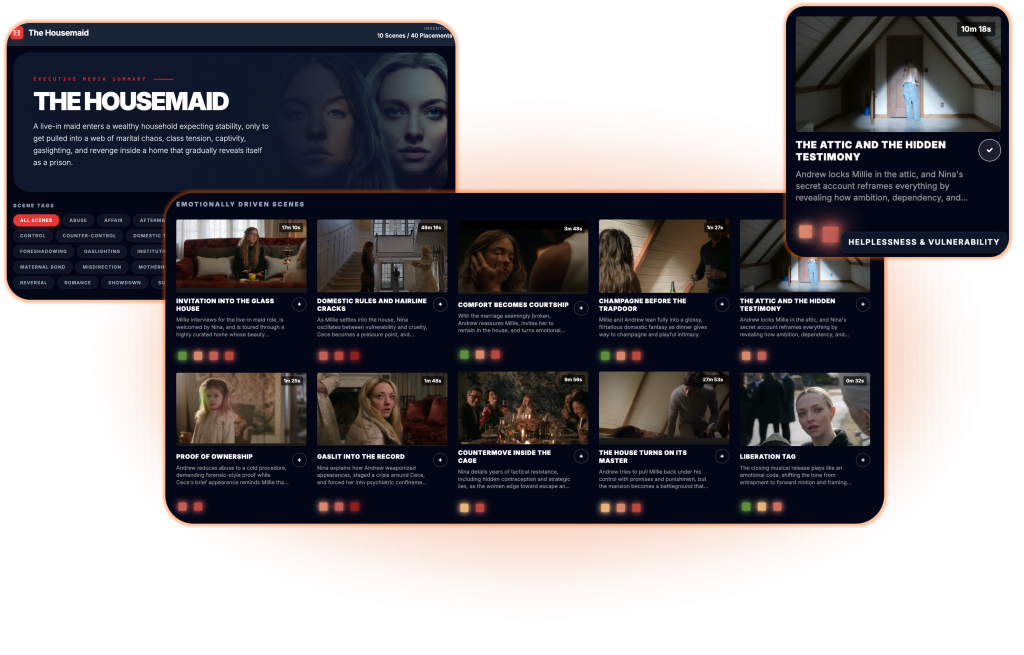
For every piece of content processed, metaADS identifies the ten most commercially significant scenes and returns the following for each
- Precise timestamps, the exact moment, not a rough window
- Emotional tags, the dominant feeling state of the scene (tension, joy, aspiration, intimacy, triumph)
- Narrative arc position, whether the scene is rising action, a climactic beat, a moment of resolution, or a tonal shift
- IAB category alignment, which ad categories are contextually appropriate for this exact moment
- DSP-ready JSON output, no manual taxonomy work, no bespoke integration projects, no delays
The result is a metadata product built not for content cataloguers, but for media buyers. Not designed for archiving, but for activation.
Built on fifteen years of metadata intelligence, validated at scale
The power of metaADS is inseparable from the infrastructure behind it. Metaprofile has spent fifteen years building the most comprehensive TV and film metadata database in the world. One of the largest enriched TV and film metadata databases in the world, spanning hundreds of thousands of titles and millions of episodes, built on a proprietary metaDNA taxonomy and serving clients with enriched metadata across more than twenty countries, including several Deutsche Telekom NatCos, Ooredoo Qatar, du Telecom UAE, Cineverse and many more.
The metaADS scene-level engine is trained on this corpus. It does not generate contextual signals from a cold start on unfamiliar content. It applies fifteen years of structured human and AI annotation to every new title it processes, producing scene-level intelligence that is grounded, consistent, and commercially validated, not speculative classification from a general-purpose model.
This is the distinction that matters. The industry’s core challenge is not a lack of AI. It is a lack of trusted, standardised, commercially grounded AI output that buyers and sellers can act on with confidence.
Metaprofile arrives at this moment with hundreds of thousands of enriched titles already processed, a commercial taxonomy already standardised across dozens of active deployments, and an ad-tech output layer that turns emotional intelligence directly into media-buyer-ready placement decisions, not a roadmap promise, but a live product.
Admir Đozović, CEO, Metaprofile
Answering the industry’s six hardest challenges
The CTV metadata industry has catalogued its own barriers with unusual honesty. The obstacles are well understood. What has been missing is a provider capable of addressing them systematically. Here is how metaADS and the Metaprofile infrastructure do exactly that.
Standardization, a taxonomy the whole supply chain can trust
The most frequently cited barrier to scene-level contextual advertising is the absence of a universal schema. A “high tension” scene in one vendor’s taxonomy is “mild drama” in another’s. Buyers cannot trust or compare signals across providers, which means they discount them or ignore them entirely.
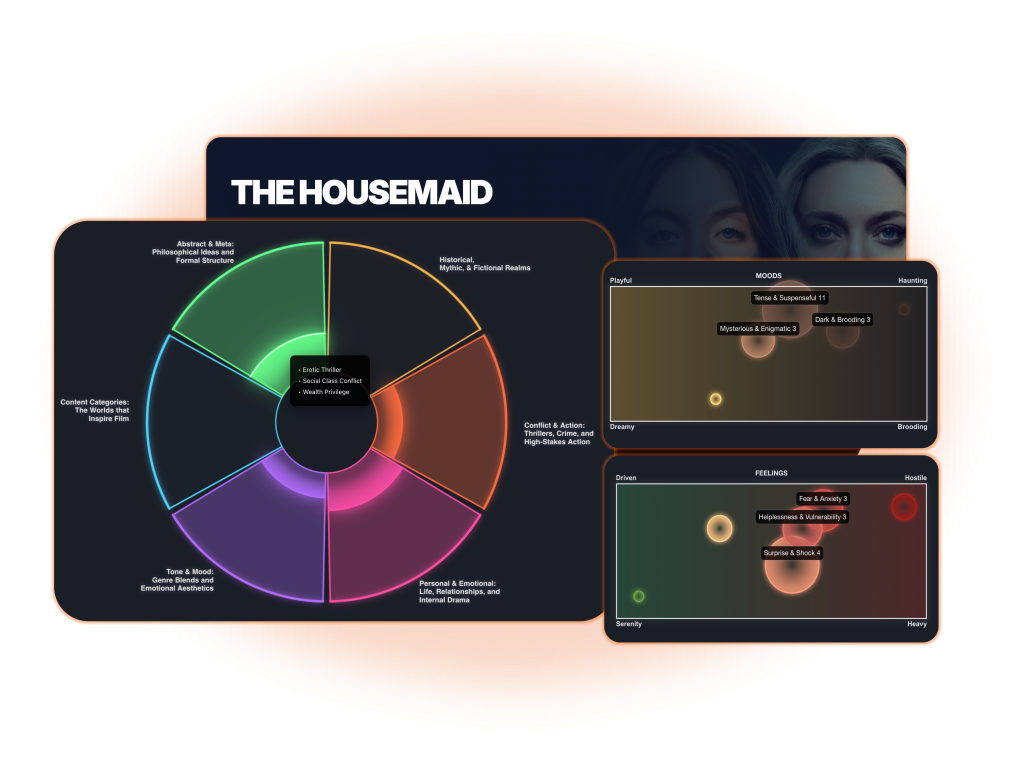
metaADS is built on Metaprofile’s proprietary metaDNA taxonomy, a controlled, structured vocabulary with unique IDs assigned to every Feeling, Mood, Cinematic Theme, and Thematic Category. These IDs are consistent across all titles, all languages, and all markets. IAB Content Taxonomy v3.0 alignment is native, not bolted on. GARM brand safety tier mapping is embedded in the output, not post-processed. When a DSP receives a metaADS JSON, it receives a standardised signal it can interpret, compare, and act on without a bespoke integration project. Metaprofile’s metadata already powers content discovery, EPG enrichment, and analytics for clients across dozens of markets worldwide. The standardisation is proven at scale. metaADS extends that proven taxonomy directly into the ad decisioning layer.
Content licensing, scene intelligence without video access
Generating scene-level metadata has traditionally been assumed to require direct access to video content, and content owners are understandably protective of their libraries. Licensing frameworks for AI-generated metadata from copyrighted content are still evolving, creating legal and commercial uncertainty for many would-be providers who have built their analysis pipelines around video file ingestion.
metaADS takes a fundamentally different approach. It does not require video file access at any point in the processing pipeline. Publishers, distributors, and FAST channel operators can integrate metaADS into their existing content delivery workflows without triggering copyright licensing complications, without video transfer agreements, and without any dependency on content owner cooperation beyond what they have already granted. The intelligence is derived through Metaprofile’s proprietary content analysis methodology, compatible with any language and any content format, across both new releases and deep library catalogues. No content access bottleneck. No single-source dependency. No licensing barrier between a publisher and their own premium inventory.
Live content latency, precision before the break, not after
Live content, like sports, represents some of CTV’s highest-value, highest-CPM inventory. It is also the hardest to tag in real time. Scene classification that arrives after the ad break has already run is not classification. It is reporting. The industry requires sub-500ms latency to make scene intelligence actionable in live programmatic environments.
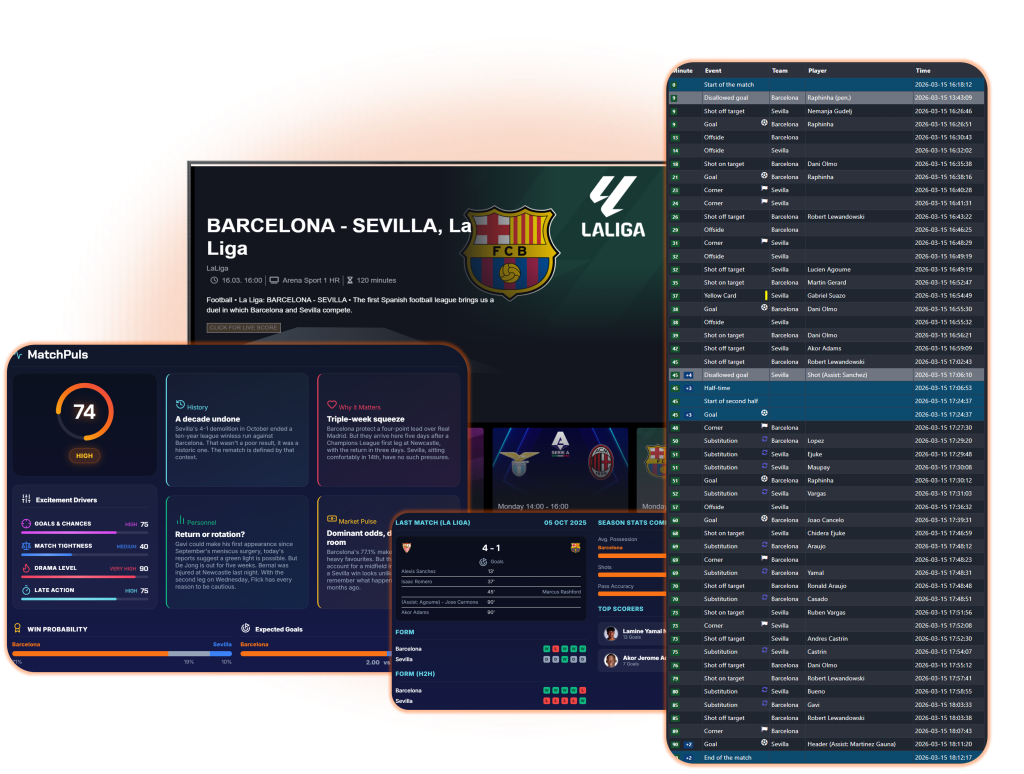
metaADS delivers validated format in under 60 seconds for VOD content. For live sports, where pre-analysis is not possible, Metaprofile’s Global Sport Hub provides real-time match metadata, event timestamps, and MatchPuls pre-match excitement scores that give buyers meaningful scene-level context before the event begins and live scoring intelligence throughout. The unique Match ID links every sports event to EPG, live scores, H2H statistics, and contextual narrative signals, giving live sports advertisers the targeting precision of VOD without waiting for post-production enrichment. No other metadata provider offers this integration out of the box.
Ecosystem fragmentation, one payload for every platform
The CTV ecosystem is, by design, fragmented. Roku, Samsung, LG, Fire TV, Apple TV, and dozens of FAST platform apps all operate distinct metadata environments. Delivering consistent scene intelligence across this landscape has been treated as structurally impossible, leading many buyers to default to the lowest common denominator, app-bundle targeting.
metaADS outputs validated format natively compatible with DSPs, ad servers, CMS platforms, and SSP bid enrichment pipelines regardless of the downstream CTV environment. Metaprofile’s existing XMLTV and JSON feed infrastructure already serves tens of thousands of TV channels across global markets and dozens of operator deployments. Rather than requiring platform-specific integrations, metaADS generates a single, portable scene intelligence payload that travels with the content, not with the platform. The same interoperability architecture that powers cross-market EPG delivery powers metaADS commercial output.
Over-blocking, turning brand safety into a revenue driver
When brand safety operates at the title level, it blunts the tool. A car chase in a family-friendly film gets the whole title blocked. A single tense scene in a drama series excludes an entire property from an advertiser’s plan. Scene-level analysis of movies and TV series consistently reveals that a substantial portion of content in genres advertisers routinely block is fully brand safe when evaluated at the scene rather than the title level. The problem is not the content. It is the bluntness of the instrument. Over-blocking is not protection. It is waste dressed as caution.
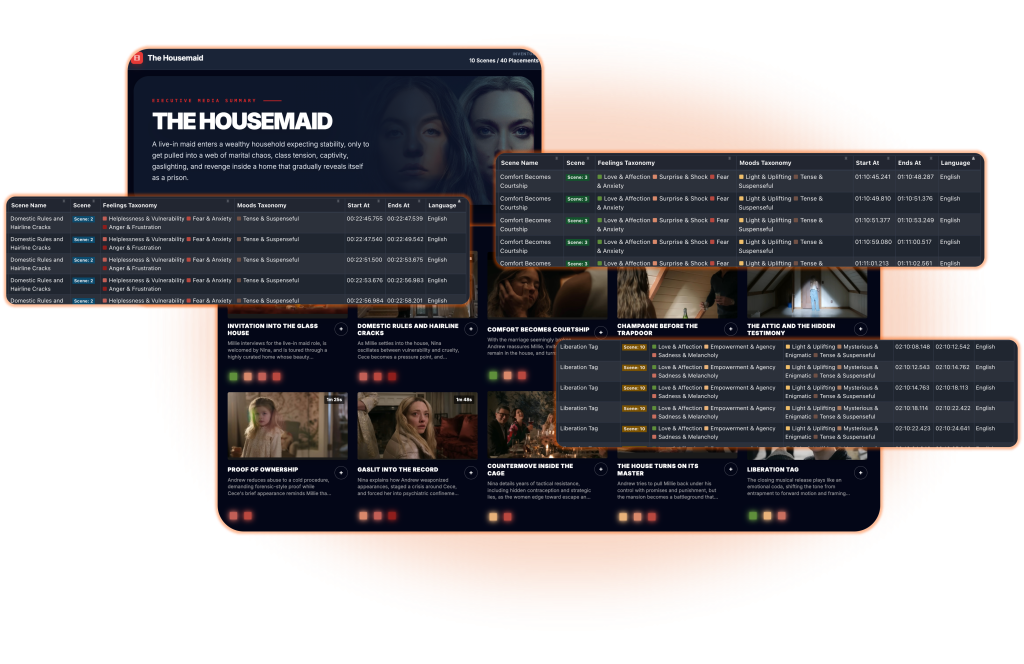
metaADS generates scene-level brand safety scores, not title-level flags, across movies and TV series. The Parental Guide layer explicitly classifies violence type and intensity, language severity, sexual content, and psychological sensitivity per scene, including descriptions of what triggers each flag. A publisher can offer advertisers a granular suitability view that identifies exactly which scenes are unsuitable and confirms that every other minute of inventory is clear. This is the commercial model that turns brand safety from a cost into a revenue driver, and it is only possible with genuine scene-level resolution.

Bid request payload, rich intelligence with lean delivery
Rich scene metadata adds payload. OpenRTB bid request size limits and processing speed requirements create real constraints on how much contextual data can travel through programmatic pipes in real time. Providers who generate exhaustive scene taxonomies face the irony that their richest data cannot physically reach the decisioning layer in time to be used.
metaADS is architected for practical integration, not theoretical completeness. Its format output delivers commercially prioritised signals, not an encyclopaedia. Each scene’s output includes the fields that media buyers actually need to make a placement decision, including timestamp, emotion, narrative context, IAB category, brand recommendation, and rationale. Machine-readable. Concise. DSP-ready without pre-processing. For environments where even this is too rich, Metaprofile’s metadata API delivers at configurable granularity, from full scene briefs to summary-level contextual scores, giving integration teams the flexibility to optimise payload size for their specific infrastructure.
Why Metaprofile
The CTV advertising industry does not need more classification vendors. It needs a metadata company with the depth, the infrastructure, and the commercial track record to deliver scene-level intelligence that buyers and sellers can trust and act on at scale. Metaprofile is that company.
We are not a startup building a taxonomy from first principles, seeking to own an emotional classification system as an investment thesis. We are not a content platform that has listed ad-break placement as a downstream capability of a discovery product. We are a fifteen-year-old global metadata intelligence company whose entire architecture has been built for one purpose alone, turning content intelligence into commercially actionable signals for the platforms, operators, and buyers who depend on it daily. That means hundreds of thousands of enriched movie titles, millions of episodes, and thousands of sport leagues across global markets, for clients who depend on our metadata for mission-critical platforms serving millions of subscribers daily.
When several Deutsche Telekom NatCos needed EPG metadata that worked across markets and languages, they chose Metaprofile. When Ooredoo Qatar needed hundreds of channels enriched and integrated in four weeks, they chose Metaprofile. When Cineverse needed the semantic metadata layer to power its AI-driven global content discovery engine, they chose Metaprofile. When AGICOA, representing tens of thousands of rights holders worldwide, needed precision broadcast data for royalty matching across European markets, they chose Metaprofile.
This is the foundation metaADS is built on. Not a demo environment. A production-proven, at-scale metadata ecosystem that extends its intelligence directly into the CTV ad placement layer, already live, already integrated, already delivering.
The commercial opportunity, what metaADS unlocks
For publishers and FAST channel operators, metaADS transforms catalog content, often commanding remnant CPMs, into contextually tagged, brand-safe, emotionally segmented inventory. Contextually enriched inventory commands meaningful CPM premiums over untagged equivalents in programmatic auctions, a dynamic that every SSP partnership and publisher yield analysis in the space now confirms. For a FAST channel with thousands of hours of library content, retroactive metaADS processing creates a new premium inventory category from content that previously sold at floor price.
For agencies and media planners, metaADS eliminates the manual taxonomy work that currently takes days. A complete, buyer-ready scene analysis for any title in under 60 seconds means campaign planning moves at the speed of opportunity rather than the speed of editorial review.
For DSPs and ad servers, metaADS JSON feeds provide the pre-bid contextual signal layer that the industry’s most sophisticated buyers have been demanding since programmatic CTV scale began. Content-level metadata is demonstrably more predictive of conversion outcomes than app-bundle targeting, a finding that has emerged consistently across independent studies, agency regression analyses, and platform-level testing. Scene-level metadata goes further still, narrowing the signal from the show to the moment, from the genre to the emotion.
For brands, metaADS makes the promise of contextual congruence real. Campaign after campaign has confirmed that ads placed in emotionally aligned scenes outperform misaligned placements on every measurable brand metric, including recall, favourability, and purchase intent. Travel brands placed in aspirational scenes. QSR brands placed in dining scenes. Finance brands placed in moments of resolution and confidence. This is not a hypothesis. It is a tested, measurable, commercially repeatable advertising strategy, and it requires exactly the kind of scene-level emotional intelligence that metaADS delivers.
Innovation leadership, what comes next
Metaprofile has not reached the end of a development journey. metaADS is a live product, and the beginning of a new chapter in how the TV advertising ecosystem uses metadata.
The roadmap ahead is clear. Multimodal foundation models will lower the cost of scene analysis and raise the ceiling on signal complexity. Edge AI processing will bring sub-500ms classification to live content environments. Scene-to-second-screen synchronization will create new cross-device advertising experiences triggered by specific narrative moments. Predictive scene intelligence, meaning models trained on viewer engagement data to forecast which scene contexts will drive the best outcomes for specific brand categories, will transform planning from reactive to anticipatory.
Metaprofile is investing in each of these vectors. Our metaDNA taxonomy, our structured content graph, and our fifteen-year metadata corpus give us a foundational advantage that no new entrant can replicate with a model and an API key.
The future of CTV advertising is contextual. The future of contextual is scene-level. And scene-level only works if the underlying metadata is standardised, commercially grounded, and trusted by every layer of the supply chain. That is what Metaprofile has built. That is what metaADS delivers.
A final word to the industry
When Cineverse unveiled Matchpoint Hex at NAB Show 2026, Metaprofile paused to recognise what the announcement represented. Matchpoint’s mission, to change the way the world discovers and connects with media content, is a mission the Metaprofile team shares deeply and has pursued, in its own way, for fifteen years, including through our work with Cineverse in developing a semantic taxonomy for feelings and moods. Matchpoint Hex, built around the Human Experience Classification System, is one of the first platforms to classify the emotional and contextual dimensions of content at scale and bring that intelligence to streaming operators, programmers, and advertisers as a product they can actually use. That is not a small achievement. It is the moment a shared belief becomes a shared industry movement. Metaprofile is proud to stand alongside that vision, as a fellow believer that emotional intelligence is the infrastructure the next generation of streaming is built on.
That shared belief is grounded in a reality every part of the industry recognises. Every serious industry survey, every agency research report, and every programmatic platform analysis arrives at the same conclusion, that the content data gap is the single biggest constraint holding CTV advertising back. The budget intentions are there. The appetite to shift linear spend into streaming is there. What is missing is the confidence that comes from knowing precisely what your ad is appearing next to, and why. The problem is not demand. It is supply, specifically the supply of metadata intelligent enough, standardised enough, and commercially actionable enough to move the needle.
The moment has arrived, and Metaprofile is already in it. The technology is live. The infrastructure exists. The track record is proven.
We built metaADS because we believe that every scene in every piece of content is a commercial opportunity waiting to be understood, and that the brands, publishers, and platforms that understand those moments first will define the next era of CTV advertising.
The industry has been buying shows. It is time to start buying moments.
About Metaprofile
Metaprofile is a global metadata intelligence company with fifteen years of experience serving clients across more than twenty countries across 5 continents. Our products include EPG Metadata, Content Discovery (metaDNA), Sports Universe, Global Sport Hub, Media Monitoring Metadata, and metaADS Contextual Ad Intelligence. Trusted by several Deutsche Telekom NatCos, Ooredoo Qatar, du Telecom UAE, Azerconnect, Cineverse, Ampere Analysis and many more.
Contact
sales@metaprofile.tv | www.metaprofile.tv
© 2025 Metaprofile Data d.o.o. All rights reserved.
- Posted by Admir
- On 30.06.2026