

SEMANTIC NATURAL SEARCH
The end of the evening scroll? Metaprofile’s bet on semantic search
Viewers usually know what they want to watch, but their TV can’t understand them when they say it. Metaprofile’s answer is semantic search: with metaSENSE, its Semantic Natural Search Engine, the company bets that the answer lies in the metadata underneath, not the menus on top.
It’s twenty to ten on a Wednesday. Tom has done the washing up, the kids are finally asleep and he has perhaps ninety minutes before his eyes start closing. He knows roughly what he wants: something light, ideally a caper where a group of likeable people steal something they probably shouldn’t. Nothing violent.
He types “heist” into the search bar and gets a wall of grim thrillers, two documentaries about real bank robberies and a crime drama he abandoned last spring. He tries “funny heist”. The search engine finds a title with “Funny” in it. Twenty minutes of scrolling later, he’s watching a rerun of something he’s seen three times, mostly out of exhaustion.
The frustrating part is that Tom knew exactly what he wanted. He just couldn’t say it in a way his television understood.
The scroll problem
The industry calls this choice fatigue, and nobody in pay-TV or streaming disputes it. A typical operator now stitches together linear channels, catch-up, its own VOD store and several streaming apps, putting more titles in front of a household on any given night than anyone could browse in a lifetime of evenings.
The tools for finding any of it have barely moved. Most search boxes still match text: a title, an actor, occasionally a director. That is keyword matching, not semantic search. Browse rows are sorted by genre or popularity, which pushes the same handful of titles at everyone.
Much of the blame lies underneath. A lot of TV metadata was built for the schedule, not the viewer. An EPG entry tells you what’s on at 9pm and roughly what it’s about. It was never meant to know that a film is warm and slow-burning. The cost is commercial as well as personal: content that can’t be found doesn’t get watched, and viewers who give up often enough start asking why they’re paying.
Semantic search: saying it the way you’d say it to a friend
Metaprofile, better known in the trade for EPG and entertainment metadata, thinks the fix starts with letting people describe what they want in their own words. Its metaSENSE product (short for Semantic Natural Search Engine) brings semantic search to TV, letting viewers type the sort of sentence they’d say to a friend who worked in a video shop.
Take a full request such as “I want to watch a feel good and happy movie about theft”. It gets broken into parts: a content type (a film), feelings (feel-good, happy) and a theme (theft). Each is then widened. Theft also covers stealing, heist, robbery and burglary; happy also covers cheerful, upbeat and positive. A film where the theft drives the story ranks above one where someone pockets a wallet in a single scene.
That raises an obvious objection. Nobody wants to type a paragraph with a TV remote, and not every set has a voice button. So the more telling test is what happens with two words. Type Tom’s “funny heist” into metaSENSE and the screen reads back what it understood: keywords heist, robbery, theft, caper, bank robbery and planned theft; genre comedy; sub-genre heist. This is semantic search at work: two words have become a detailed brief, and the results are matched against all of it. The same search that failed Tom earlier now gives him something to work with.
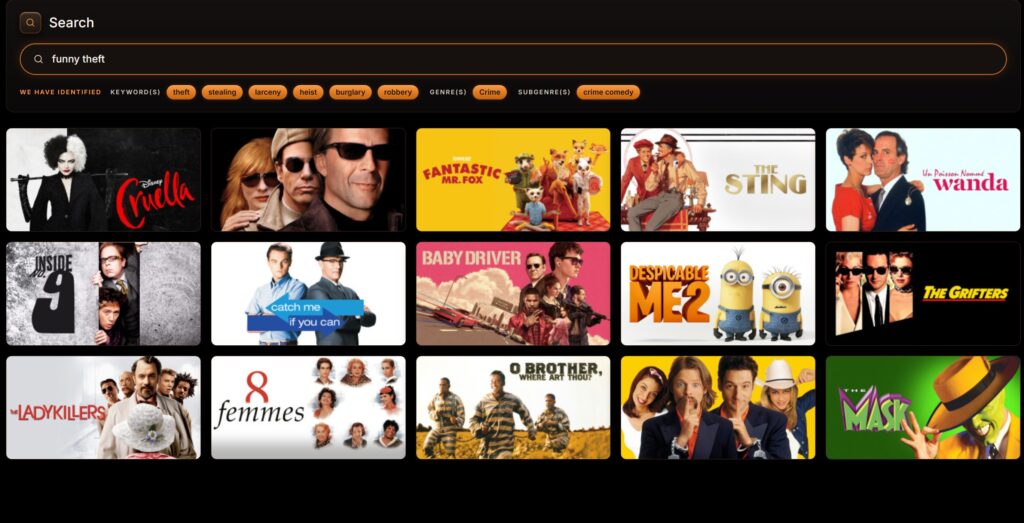
Showing those signals matters too: if the engine misreads you, you’ll see it and can rephrase. Most recommendation systems are black boxes. This one shows its working.
How semantic search works behind the search box
The first step of semantic search is understanding the request. metaSENSE uses large language models (the kind of AI behind chatbots) to work out what someone means, and it tolerates small typos.
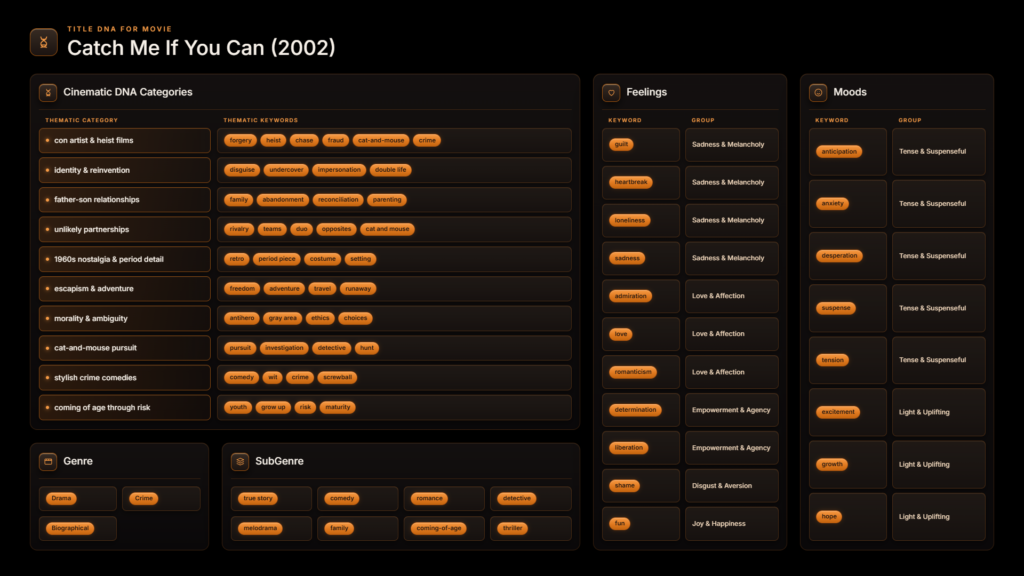
The second step matters more. Every title has a profile from Metaprofile’s metaDNA system covering cinematic themes, narrative arc, feelings and moods, intensity, visual and narrative style, scene-level elements, keywords, genre and sub-genre. In short, it records both what a story is about and how it feels to watch. Titles matching more signals rank higher, as do those where the requested theme is central rather than incidental.
Every metaDNA tag also has an ID that doesn’t depend on any one language. “Heist” in English and its equivalents in Arabic or Croatian point to the same concept, so semantic search behaves the same way in any market without re-tagging the catalogue country by country.
Why this semantic search can’t make things up
This is where metaSENSE differs most from the wave of AI search now arriving on TV. Ask a general-purpose chatbot for a cheerful robbery film and you’ll get a confident answer, but large language models are known to “hallucinate”: inventing plot details, mixing up similar titles, even recommending films that don’t exist. In a chat window that’s irritating. On a TV platform carrying the operator’s brand, it’s a liability.
metaSENSE keeps the AI on a short lead. The language model interprets the request; it doesn’t decide what a film is about or pick titles from its own general knowledge. That job belongs to the metaDNA profiles, and Metaprofile keeps full control over that data. Titles are normalised (structured in one consistent format, so the same film isn’t listed three ways from three sources) and enriched to quality standards the company sets and checks itself.
So every title in the results exists in the catalogue, and every reason it appears traces back to a tag in its profile. The same request gives the same answer tomorrow as today.
Who gains
For telcos, pay-TV operators and IPTV providers, discovery is one of the few parts of the TV experience they control directly, and one of the few places to stand apart from rivals carrying the same channels and apps. Better semantic search should mean more time on the platform and less churn, without building an AI team in-house.
Broadcasters and streamers get a fairer shot for the back catalogue. Older, local and niche titles get found for what they are, not for how many people watched them last week. And for product teams, language-independent tagging makes launching in a new market far less painful.
For viewers like Tom, the gain is simpler: less scrolling, results that fit the evening’s mood, titles they never knew existed, and a search box that understands how people actually talk, in their own language.
The interface is the easy part
TV discovery is heading towards conversation. Voice remotes are common, and AI assistants are arriving in TV operating systems and set-top boxes. But an interface is only as good as what it’s talking to. Put a fluent AI assistant in front of thin or unchecked metadata and you get a very polite way of serving the wrong film, or one that doesn’t exist. Understanding the sentence is becoming the easy bit. Semantic search is only as good as the metadata behind it: knowing what every title is about, and how it feels, is where the real competition will be decided.
Back on the sofa, Tom doesn’t care about metadata layers. He wants a funny film about a robbery and to be asleep by half eleven. If the next generation of TV search gets that right, he’ll never give it a second thought. Which is rather the point.
- Posted by Admir
- On 26.10.2026