

Beyond the Guide: Why AI Metadata Is Becoming the Infrastructure of Television
How data ownership, architecture, and semantic AI are quietly reshaping how the world discovers, watches, and monetizes video.
For most of its history, television metadata was a byproduct rather than a product: a schedule typed up so a guide could be printed, a genre and cast logged so a search box could find them. That thin layer of description worked when a viewer’s choice was a few dozen channels and a printed grid. It stops working once that same viewer is choosing across a package running into the hundreds of linear channels, a CTV home screen stacked with competing apps, thousands of FAST channels layered on top, and every football match on the planet happening at once. What we’ve built in its place is entertainment metadata rebuilt as engineered infrastructure, governed the way any mission-critical data system should be, with AI doing the work of turning raw broadcast signal into meaning. We’ve watched the industry’s own conversation shift accordingly: less about whether AI belongs in the metadata stack, more about which deployments are actually running in production.
Why AI has become non-negotiable in TV and entertainment metadata
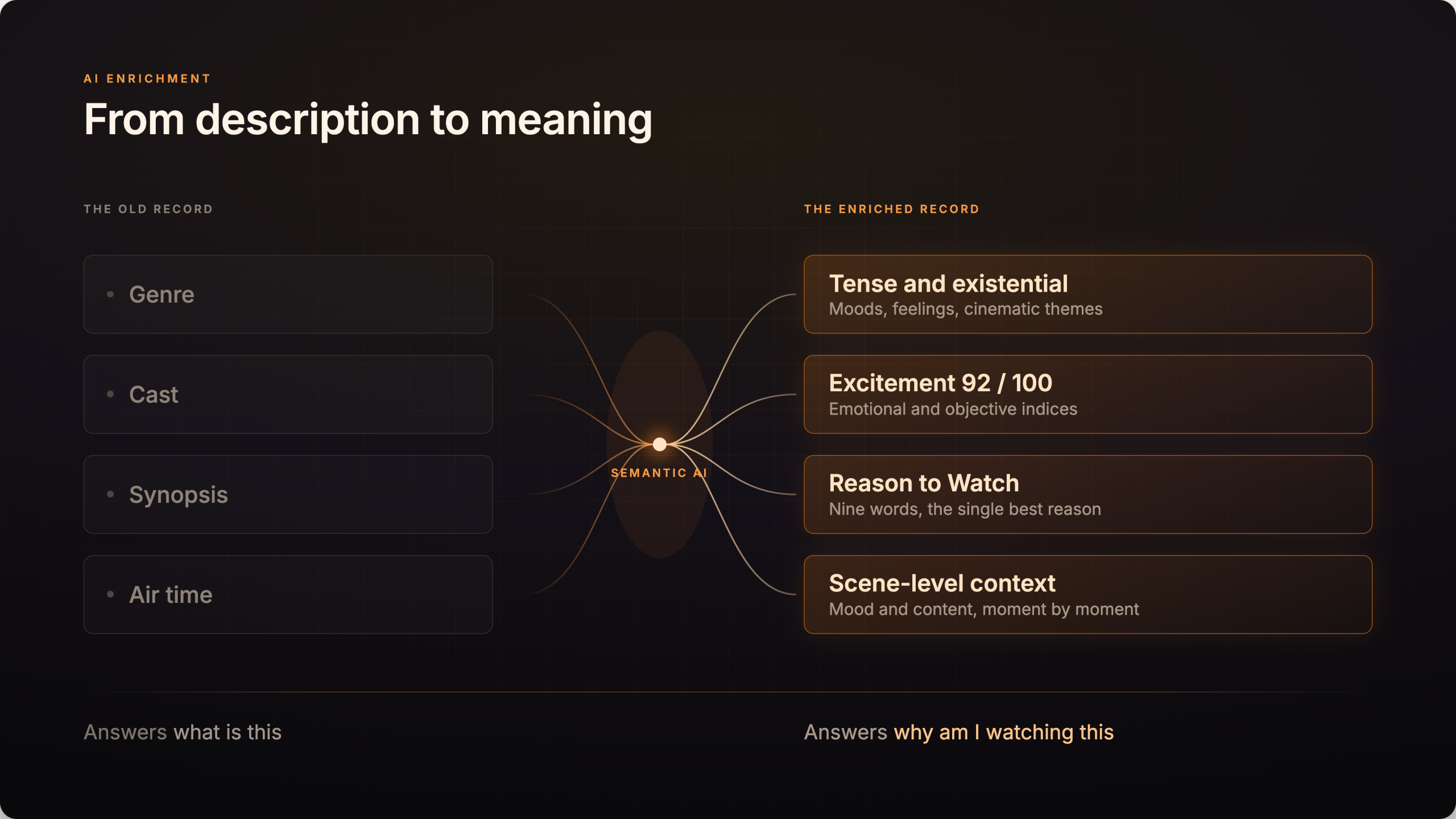
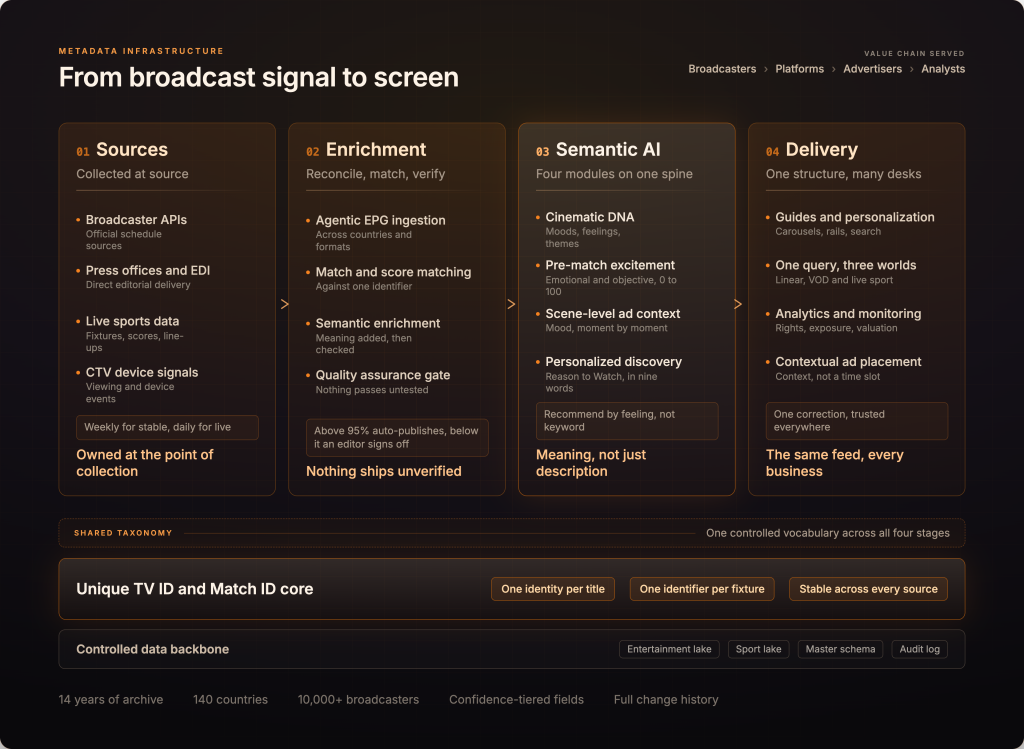
The traditional metadata stack (genre, cast, synopsis, air time) answers “what is this” but not “why would I want this,” which is the question viewers are actually asking when a guide holds thousands of titles. We built our AI Enrichment Pipeline to treat that gap as the central problem: agentic EPG ingestion reconciles schedules across countries and formats, real-time match and score matching runs against a unique identifier, a semantic enrichment stage applies, and nothing reaches a client dashboard or viewer screen without passing our quality-assurance layer first.
Sport is the sharpest test of this, and arguably television’s biggest transformation story right now, as rights fragment and broadcasters compete on fan engagement rather than access alone. Our Excitement Score blends an emotional index (narrative stakes, star power, historical drama) with an objective index of competitive stakes, balance, and expected goals into a single 0 to 100 pre-match value, recalibrated after every match and refreshed again as a fixture is played. That score is what lets a platform auto-populate a “Most Exciting Today” carousel across hundreds of simultaneous fixtures, a new kind of viewing experience no human editorial team could produce fixture-by-fixture in real time.
We apply the same logic to entertainment. Our metaDNA engine assigns each film or series a layer of moods, feelings, and cinematic themes alongside genre and cast, so a platform can recommend by “tense and existential” rather than keyword alone, shifting the underlying question from “what is this about” to “why am I watching this.” When Cineverse set out to build the semantic layer behind its AI-driven global content-discovery engine, we worked directly with them to help shape that same taxonomy of feelings and moods, work that fed into Matchpoint Hex, the classification system Cineverse introduced at NAB Show 2026. Semantic metadata isn’t a slide-deck concept to us: it’s something we build jointly with the companies that depend on it.
Why data collection, control, and ownership are the precondition for any of it working
AI enrichment is only as trustworthy as the data beneath it, and this is where the real competitive line is drawn, not in whose model is cleverest, but in whose pipeline can be audited. Most of our EPG data is collected directly from official broadcaster sources (APIs, press offices, electronic data interchange), with the remainder from vetted third-party partners, each carrying a reliability score based on accuracy and timeliness. We match collection cadence to volatility: stable schedules are pulled weekly, live-sports and news channels refreshed daily.
Ownership matters most at the normalization layer. If we didn’t control our own ingestion pipeline, we couldn’t guarantee schema, time-zone handling, or taxonomy discipline downstream. We leave ambiguous fields null rather than guessing, version every schedule change, and tag data with tiered confidence levels: above 95 percent for broadcaster-sourced fields, down to explicitly flagged lower confidence for preliminary schedules. That discipline is also what makes ownership a genuine moat for us: with direct broadcaster relationships across a hundred and forty countries, we control our own quality curve, while a company licensing someone else’s aggregated feed inherits whatever gaps that feed already has, with no way to fix them.
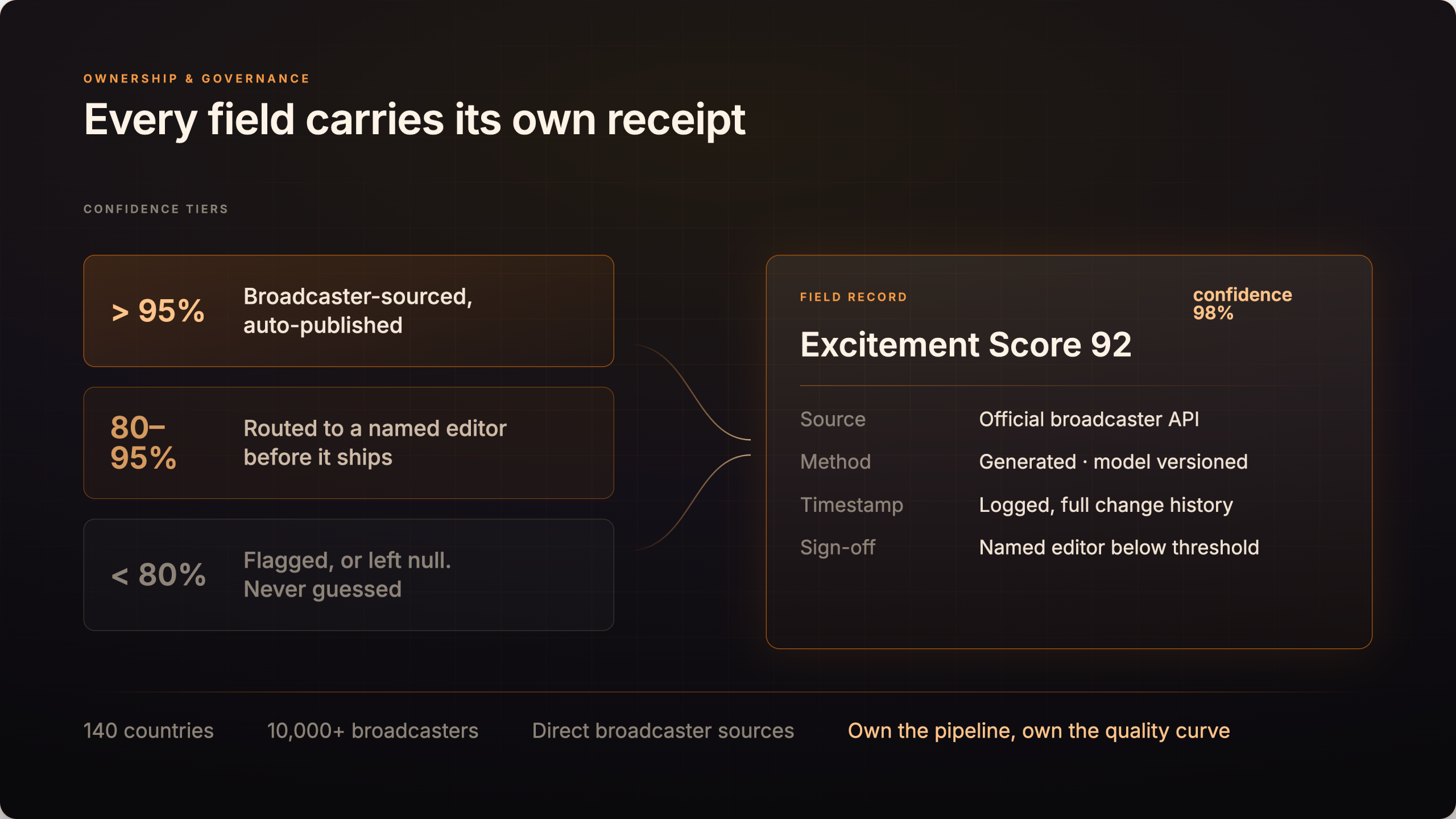
It’s also our quiet answer to a louder industry question. Much of the current conversation about trust in media is aimed at whether video and audio are genuine; metadata has a narrower but no less real version of that problem, and it’s one we’ve built our pipeline to answer. Every AI-generated field we ship carries its own record of origin: source, generation method, timestamp, and, below a defined confidence threshold, the name of the editor who signed off before it shipped. We don’t think a platform can call itself ready for an AI-native future if it can’t answer “why should I trust this field,” no matter how good its recommender is.
Why sustainable architecture, not clever models, is the real differentiator
Architecture is what makes AI enrichment durable rather than a collection of one-off integrations. At the center of our platform sits a “Unique TV ID and Match ID Core”: one persistent identity per title, one match identifier per fixture, consistent whether the data comes from a broadcaster feed, a live-stats provider, or a CTV signal. Every other layer we run, from the editorial EPG baseline to our four semantic AI modules (cinematic-DNA, pre-match excitement, scene-level ad context, personalized discovery), draws on that same spine rather than maintaining incompatible IDs of its own.
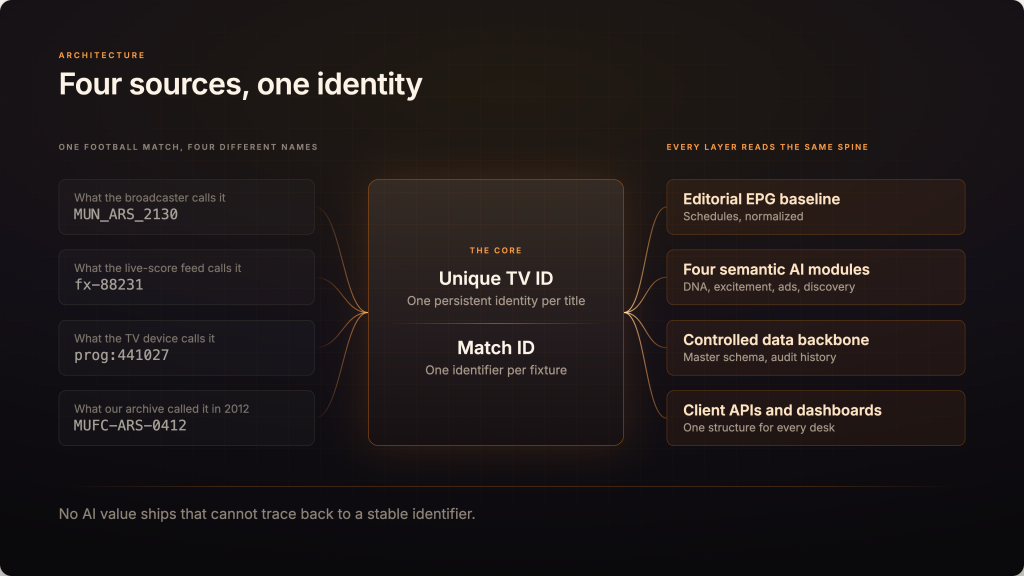
Underneath sits what we call our “Controlled Data Backbone”: separate entertainment and sport data lakes, one master schema across every market we operate in, and an audit-and-logging layer preserving full change history. A shared schema lets us onboard a new broadcaster or sport without re-architecting anything; a bespoke schema per client would accumulate debt until quality diverged unpredictably between markets, not something we could sustain across a fourteen-year archive spanning ten thousand-plus broadcasters and a hundred and forty countries.
We didn’t arrive at this emphasis on governed intervention over blind automation in a vacuum: it mirrors a wider shift already underway across major European telecom and media groups, many of which are now putting their own responsible-AI principles into writing: automation paired with continued human oversight, a preference for sovereign, auditable infrastructure over opaque black boxes. An architecture that auto-publishes only above a defined confidence threshold, routes everything below it to a named editor, and keeps a full audit trail is that same discipline applied one layer down the stack, and it’s the standard we hold ourselves to. Our LiveScore proof-of-concept, a middleware layer polling the sports API every sixty seconds and pushing complete, not incremental, match-state messages to set-top boxes, is one example of that same judgment surviving contact with live, unpredictable input.
Why all of this matters for usability, personalization, search, and discovery
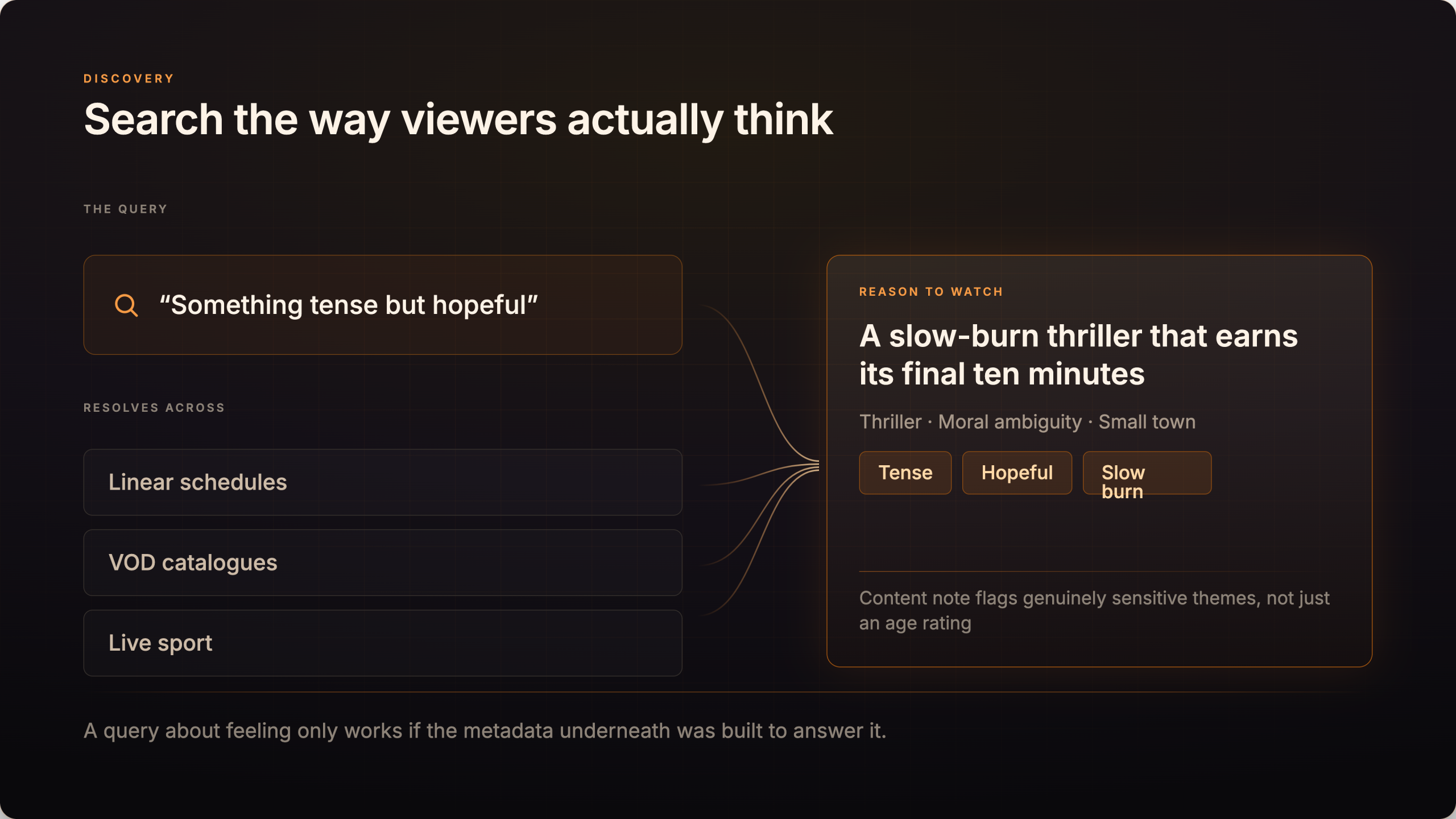
Ask any platform product team what audiences want and the answer increasingly comes back as choice, curation, and context: a faster route to the right title, not more of them. Semantic tagging is what makes that curation possible at scale: one query returning relevant results across linear, VOD, and live sport at once, because we describe all three in the same underlying language. “Something tense but hopeful” only works as a search query if the underlying metadata was built to answer it.
Our “Reason to Watch” specification is the clearest expression of this: a nine-word hero badge explaining the single best reason to watch a title, paired with a genre-and-theme breadcrumb, an insider production fact, a labelled cast pairing, three “vibe” tags, and a content note that goes beyond a bare age rating to flag genuinely sensitive themes. We don’t hand-write that copy at this scale; we generate it against a structured prompt pulling directly from our semantic layer, which only works because that layer already exists in governed, queryable form.
We apply the same logic to sport personalization. Because we build the Excitement Score from explainable sub-components, a platform can bias it toward a viewer’s known affinities and still explain the result in plain language: “a historic derby with title implications” rather than a bare number. That combination of personalization and explainability is what turns a recommender from a black box into something a viewer trusts enough to act on, which is the whole point of the work we put into this layer.
Why the same infrastructure is reshaping CTV, analytics, and media-monitoring businesses
The same metadata spine we build for a viewer-facing guide is equally load-bearing for customers who never see a carousel: media-monitoring firms, rights holders, advertisers, and analytics companies who consume our data rather than the video itself. Our normalized, confidence-scored EPG feed supports competitive intelligence on broadcaster scheduling strategy, rights valuation and exposure measurement, sponsorship-inventory identification, and longitudinal tracking of genre and platform trends, none of which works without the same schema discipline and source-confidence scoring we described earlier.
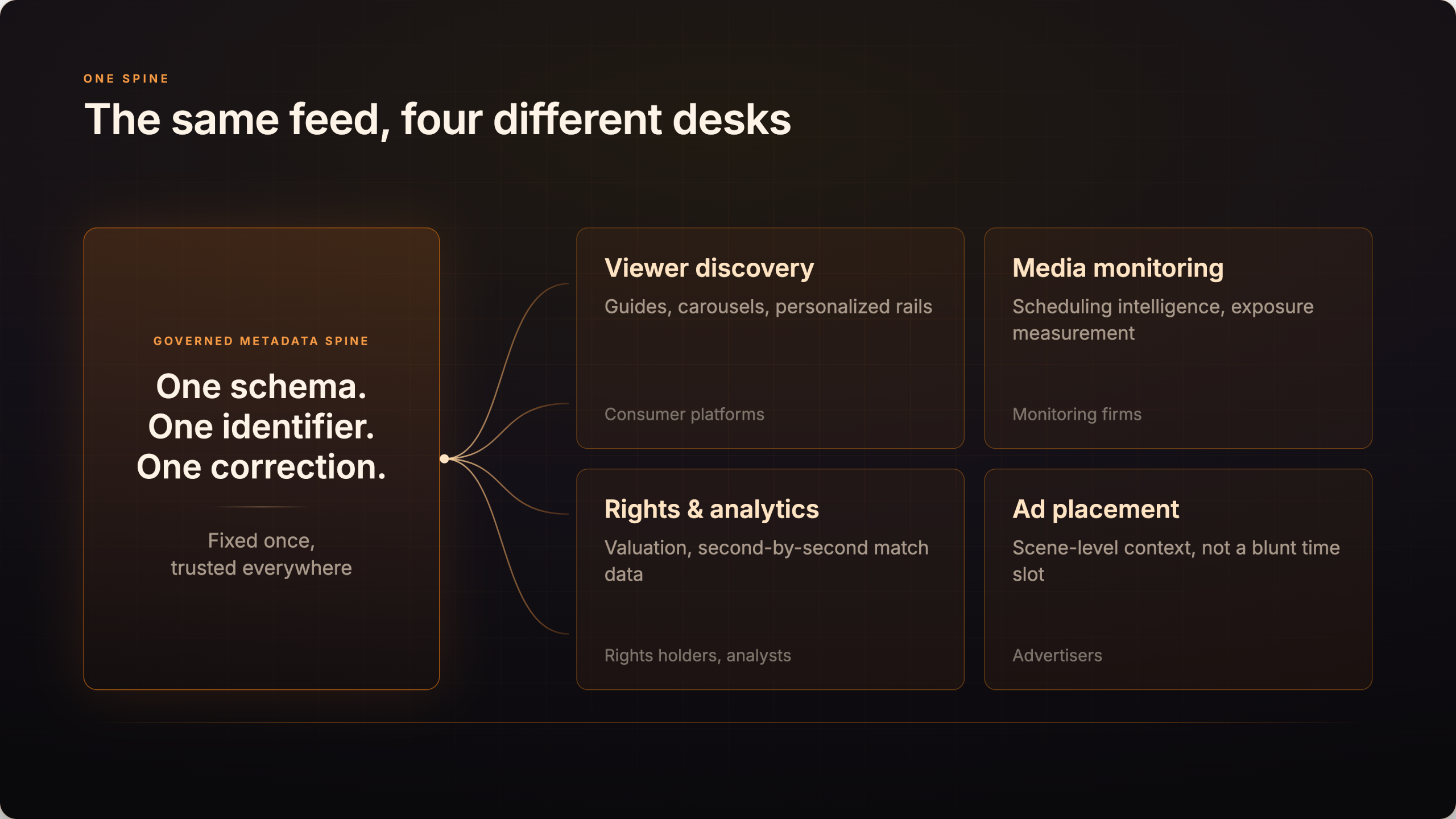
Sport pushes this further into real-time analytics. Our structured sports API delivers match, team, and player statistics down to the second, and it’s simultaneously the feed a broadcaster’s live-score overlay consumes and the feed an analytics platform ingests for its own modelling. Because we deliver it as one governed structure rather than two products, a correction only has to happen once to be trusted everywhere. That’s the same consistency that makes automated ad insertion viable: our scene-level ad-context engine understands mood and content at a granular level, so it can place advertising against context rather than a blunt time slot, turning the same pipeline into a monetization tool without a separate metadata product.
Owned data, governed architecture, and semantic AI are, increasingly, the same story we tell from three different desks.
What is next
The next three years are our plan is to keep that same standard running, at greater scale.
Admir Đozović, CEO, Metaprofile
That belief is concentrated in four pillars: operational efficiency and responsible automation, data quality and trustworthiness, content discovery and personalization, and new, compliant revenue streams built on the metadata layer itself.
On efficiency, we’re focused on speeding up the unglamorous middle of our pipeline (matching schedule entries to canonical records, resolving cross-source collisions) without loosening our rule that low-confidence values still get a human editor’s sign-off. On quality, we’re extending the same confidence-tiered, audit-logged discipline across every language and market we serve. On discovery, we keep broadening metaDNA, we’re extending Reason to Watch into full series-and-episode awareness, and we’re moving the Excitement Score beyond football into the other sports we already track through our Global Sports Hub. On revenue, our scene-level ad-context engine, the kind of work Cineverse has been building on, is rolling out brand-safety scoring, audience overlays, and ad placement triggered directly off programme metadata.
None of it works for us if it comes at the expense of our architecture’s founding constraints: we won’t lower the human sign-off threshold, we won’t surface an AI value that can’t trace to a stable identifier, and we won’t bypass our audit framework to move faster. For an industry moving quickly toward AI-native platforms, we think that combination, an ambitious roadmap paired with non-negotiable governance, is the more interesting commitment of the two.
About Metaprofile
Metaprofile is a global metadata intelligence company with fifteen years of experience, running a fourteen-year enriched archive across more than a hundred and forty countries and ten thousand-plus broadcasters. Our products include EPG metadata, Content Discovery (metaDNA), Excitement Score, Global Sport Hub, media-monitoring metadata, and metaADS contextual ad intelligence.
Contact
sales@metaprofile.tv | www.metaprofile.tv
(c) 2026 Metaprofile Data d.o.o. All rights reserved.
- Posted by Admir
- On 26.08.2026